
VIDEO TRANSCRIPTION
Echoes of Israel
Life in 586 BCE: No Soap, No Clean Water — The Dark Truth of Ancient Israel
Description generated by Skrybot
The information provided paints a vivid picture of daily life in ancient Israel, focusing on the ordinary people who lived in villages and engaged in activities like grinding grain, fishing, and participating in communal rituals. The narrative highlights the struggles, rituals, and interconnectedness of these individuals, emphasizing their shared experiences, challenges, and hopes within a complex social and economic landscape.
Transcription generated by Skrybot
Two thousand years ago, in a land caught between empires, ordinary people woke before dawn and carried the same weight you carry today. The weight of not knowing if tomorrow would be kinder than yesterday. Imagine standing at the edge of a village in ancient Israel, somewhere between the Sea of Galilee and the dry hills of Judea. The sky above you is deep purple, fading into rose, and the first sounds you hear are not trumpets or the roar of armies. They are the sounds of a woman grinding grain against stone, the bleating of a goat tied to a post, and the low murmur of a man praying in the direction of Jerusalem.
These are the sounds of a life that most history books forget, the life of the ordinary person, not the king, not the priest, not the general, the farmer, the merchant, the mother, the child. And what you are about to witness is not a lesson. It is a journey, a journey into a world that breathed, struggled, laughed and believed with the same ferocity that you do now. But before we go any further, there is something you need to know, something that changes everything about how we understand those ancient streets and stone houses. Something that most people who have heard the stories of this land have never truly stopped to feel. Stay with us. The land itself was the first character in every story told here.
Ancient Israel, the region also known as Judea and Galilee, sat at a crossroads where three continents breathed against each other. Africa to the south, Asia unfolding endlessly to the east, and the restless Mediterranean pressing from the west. This geography was not background, it was destiny. Trade caravans passed through constantly, carrying spices, linen, copper, and rumors. Soldiers from Egypt, Rome, Persia and Greece had all left their footprints in this dust at one point or another. And yet, the people who lived here, the farmers, the fishermen, the potters, the weavers, they were not defined by the empires that passed over them. They were defined by something older and more stubborn than any empire. They were defined by their roots.
their rituals and their remarkable ability to hold on to identity in a world that was constantly trying to dissolve it. Walk now into the village, not the city, not Jerusalem with its towering temple complex and its crowd of pilgrims and merchants, not Caesarea Maritima with its Roman columns and marble baths. Walk into a small village, a moshav as some would later call it, a cluster of stone and mud brick houses perched on a hillside, surrounded by terraced fields and olive groves that have been tended by the same families for generations. This is where the vast majority of people in ancient Israel actually lived. Scholars estimate that roughly 90% of the population were peasants, craftsmen or subsistence farmers. The grand stories happened in the cities.
The real story of this civilization happened here, in the dust and the labor and the prayers whispered at dusk. The houses themselves tell you everything if you know how to listen. Most families in this period lived in what archaeologists call an Israelite four-room house. Though by 2000 years ago, the design had evolved and adapted in dozens of regional variations. The structure was typically built from field stones gathered off the hillsides, fitted together without mortar, and then plastered with a mixture of mud and straw on the inside. The roof was flat, made of wooden beams covered with packed earth, and it was not merely a roof, it was a room in itself.
On summer evenings, families moved their sleeping mats up to the roof where the night air was cooler and the stars were close enough to touch. Children fell asleep beneath skies so dense with light that the darkness itself seemed to glow. Inside, the house was divided into functional spaces that told the story of a life organized around survival, and community. The ground floor was often shared with the family's animals, not out of primitive necessity, but out of practical wisdom. The body heat of goats and donkeys helped warm the space on cold desert nights, when temperatures could drop sharply even in regions that burned at midday. The smell was constant, the straw was constant, and the intimacy between human life and animal life was constant.
There was no sharp division between the natural world and the human world. They breathed the same air and shared the same walls. The main living area contained a central hearth, typically a circle of stones, where fire burned for cooking, warmth, and light. Olive oil lamps, small ceramic vessels with a wick dipped into oil, flickered in the corners, casting a warm and uncertain light that made every shadow move. These lamps were so fundamental to daily life that they appear in countless stories and parables. from this period. When one went out, the whole house felt it. The oil that fueled them was not just practical, it was precious. It was pressed from olives that required years of cultivation, weeks of harvest, and days of labor to produce produce.
Every drop carried the weight of that work. The morning began with grain. This was not a metaphor. Every morning in nearly every household across ancient Israel, the sound of stone grinding against stone was the first sound of a new day. Women and in poorer households children ground wheat or barley between two flat millstones to produce the coarse flour that would become the day's bread. This task was so universal, so fundamental to daily survival that rabbinic texts from the period would later list it among the essential duties of a wife. And yet it was backbreaking. Thirty minutes of grinding produced enough flour for perhaps one loaf. A family of five needed much more than that.
The labour of morning meant that the day had begun before the sun had fully risen, and it would not end until long after it had set. The bread that emerged from this labour was not the soft uniform loaves of a modern kitchen. It was dense, flat, slightly sour from leaven, and it was the center of every meal. In Hebrew, the word for bread, lechem, was often used interchangeably with the word for food itself. To ask for bread was to ask for survival. To break bread with someone was to enter into a relationship of trust and mutual dependence. The sharing of food in this culture was never casual. It was a declaration.
When you ate at someone's table, you were saying something about who they were and who you were. And this is why so many of the most charged moments in the stories that came out of this land happened around a meal. Water was the second obsession of daily life, and in many ways it was more pressing than food. The region of ancient Israel experienced a dry season that could last from late spring well into autumn, six months or more without significant rainfall. During this time, communities depended entirely on cisterns, wells, and carefully managed seasonal springs. Cisterns were large underground chambers carved into the bedrock and plastered to prevent seepage, filled during the rainy season to sustain life through the dry months. Collecting and managing water was not a chore left to chance.
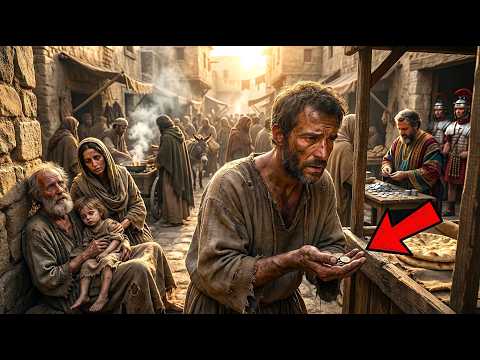
It was a serious communal responsibility. The village well was not simply a water source. It was a social center, a place of news and gossip and courtship, a place where the rhythms of community life were negotiated and maintained. Young women who came to draw water in the cool of the morning were not simply fetching water. They were participating in the social fabric of the village, and everyone who passed by understood that. Now imagine the marketplace, or what passed for one in a smaller village. usually a flat area near the village gate where traders and craftsmen gathered on certain days to exchange goods. Here the economy of ancient Israel revealed itself in its most honest form. The vast majority of transactions in rural communities did not involve coins.
They involved exchange. A farmer brought olive oil and received pottery. A shepherd brought wool and received dried figs. A craftsman repaired a plow and received a measure of grain. This was not a primitive economy, it was a deeply social one, built on webs of obligation and reciprocity that held communities together far more effectively than any currency. Coins did exist, of course, and in increasing numbers as Roman influence spread across the region. But for many families in the rural villages of Galilee or the hill country of Judea, coins were rare enough to be remarkable. The famous parable of the woman who sweeps her whole house searching for one lost coin capture something real about the economic reality of common people in this time. A single coin was not trivial, it was significant.
It represented something earned through days of labor, or saved through weeks of sacrifice. craftsmen of ancient Israel occupied a peculiar social position. They were neither the poorest nor the most prosperous members of their communities, but they were among the most essential. Potters shaped the vessels that held every liquid and every grain. Carpenters fashioned the the yokes for oxen, the doors for houses, the frames for plows, weavers produced the garments that clothed every body. And yet the texts of this period often reflect a certain ambivalence toward manual craftsmen, a tension between the dignity of skilled labour and a social hierarchy that privileged those who owned land. A carpenter was respected, but a landowner was envied. A potter was necessary, but a merchant was admired.
This tension ran through the social fabric of the culture like a fault line, subtle but real. Clothing in ancient Israel was far more complex and communicative than we often imagine. The basic garment for both men and women was the tunic, a simple rectangular piece of woven cloth with openings for the head and arms. Over this, people wore a larger outer garment that could also serve as a blanket at night. The materials varied enormously depending on wealth and region. The poorest wore rough wool or coarse linen, while the more prosperous dressed in finer fabrics, sometimes dyed with expensive pigments. Color was not decoration, color was information.
Certain shades of blue and purple were associated with wealth and status because the dyes that produced them were extraordinarily expensive, derived from rare sea creatures along the Mediterranean coast. To wear blue was to make a statement, to wear white was to signal purity or occasion, and certain religious garments were prescribed in careful detail, communicating identity and covenant in every thread. The rhythm of the week was unlike anything we experience today. Six days of labor were followed by the Sabbath, a day of rest so complete and so carefully observed that it reorganized the entire structure of time. From sunset on Friday evening to the appearance of three stars on Saturday night, work stopped. Not gradually, not partially, but completely. The fires that could not be lit.
The bread that had to be prepared in advance, the distance that could not be walked, these were not burdens for most families. They were structure. They were the architecture of time, the framework that gave the week its meaning. The Sabbath was when the family gathered entirely, when conversation replaced labor, when the texts were studied and the prayers were sung. It was in a culture of relentless physical toil, a weekly reminder that human beings were not merely productive bodies, they were souls. But not everyone felt the Sabbath the same way. For the poorest families, the day of rest was also a day without earning. For day laborers, And there were many in this period, men who had lost their land to debt or taxation and now worked for wages.
A day without work was also a day without pay. The social reality of ancient Israel was layered with inequalities that the religious calendar could sometimes ease but could never fully resolve. Debt was a constant shadow. The taxation system under Roman occupation pressed heavily on agricultural communities. A farmer might owe taxes to Rome, tithes to the temple, and debts to a local lender all at the same time. and in a bad harvest year, these obligations could crush a family that had no margin for failure. If you have ever felt the anxiety of financial pressure, the weight of obligations that exceed your capacity to meet them, then you are feeling something that the ordinary people of ancient Israel understood profoundly. This was not a distant or abstract struggle for them.
It was the texture of daily life. And it is why so many of the stories and teachings that emerged from this culture speak with such urgency about debt, about fairness, about the obligations of the wealthy toward the poor. These were not theoretical questions, they were existential ones. The religious life of ordinary people in ancient Israel at this period was rich, communal, and constantly negotiated. The temple in Jerusalem was the symbolic and ritual center of Jewish life, a structure of such magnificence that visitors from across the Roman world recorded their astonishment at its size and grandeur. Three times a year, during the festivals of Passover, Shavuot, and Sukkot, families were expected to make the pilgrimage to Jerusalem if they could.
For those living in Galilee, this was a journey of several days on foot, following roads that climbed and descended through the hills of Samaria or along the Jordan River. It was not a casual undertaking, it was a commitment. And yet families made it year after year, because the act of arriving in Jerusalem and offering sacrifice at the temple was not merely religious observance, it was identity, it was belonging, it was the annual renewal of a covenant. that had defined this people for centuries. But for the other 350 days of the year, religious life happened locally. The synagogue had emerged in the Second Temple period as a community institution, a place of gathering, reading, prayer and teaching that existed in virtually every village and town across the Jewish world.
Unlike the temple, the synagogue required no priesthood to function. Any adult male with sufficient knowledge could lead the reading. The Torah scrolls were read aloud because most people could not read privately. Literacy rates in ancient societies were low, and the reading of sacred texts was a communal experience. . . . heard and discussed and absorbed through the body as much as the mind. Children learned through listening. They learned the prayers before they could read them. They learned the stories before they understood their full weight. And in a culture without books in the modern sense, memory was not a supplement to learning. Memory was learning. The ability to recall, to recite, to connect the present moment to the thread of inherited narrative.
This was the highest form of education. A child who could quote the Psalms, who knew the stories of the patriarchs and the prophets, who understood the structure of the laws. This child was educated, regardless of whether they had ever held a stylus or marked a piece of clay. The education of children was also deeply gendered. Boys from families with resources might study under a local teacher or scribe, learning to read the Torah and perhaps to write. Girls learned primarily within the household, the management of food, cloth, the care of younger siblings, the rhythms of domestic religious life. This was not considered lesser. Within the framework of this culture, the household was not a diminished space.
It was the space where the covenant was lived daily, where children were first taught to recite the Shema, where Sabbath was observed, where Passover was celebrated. The woman who managed that space was managing the transmission of civilization itself. And yet, we must be careful not to romanticize. The lives of women in ancient Israel were circumscribed in ways that were real and often painful. Legal status was mediated through fathers and husbands. The ability to initiate divorce was largely reserved for men. A widow without male relatives was among the most vulnerable members of society. The repeated emphasis in the legal and prophetic literature of this period on the obligation to care for widows and orphans was not incidental. It reflected a genuine genuine social crisis.
A recognition that the system as it existed could leave certain categories of people with almost no protection. There is a tenderness in these acknowledgements though. Alongside the inequality, there is evidence of genuine care, genuine community, genuine relationships that cross the formal hierarchies of the culture. The neighbourliness that characterised village life was not merely social convenience. It was survival strategy and moral commitment simultaneously. When a family's harvest failed, neighbors brought food. When a child was born, the women of the village gathered. When someone died, the entire community participated in the mourning. The tearing of garments, the sitting on the floor, the meal of condolence brought by friends, the seven days of shiver that held grief within communal structure. You did not grieve alone here. Grief.
Like everything else in this culture was a shared experience. Death was present in a way that modern life has largely learned to conceal. Infant mortality was high. Estimates suggest that perhaps a third of children died before reaching their fifth year. Disease moved through communities without warning. Wounds that would be minor inconveniences today could be fatal. And yet, the relationship with death in this culture was not one of defeat or denial. It was integrated. The dead were buried quickly because the climate demanded it, and the mourning rituals that followed were elaborate precisely because the loss was expected to be profound. Grief was respected, given time and space and communal support.
And the belief that animated much of the spiritual life of this people, that death was not the final word, that justice would ultimately prevail, that the suffering of the present moment was not meaningless, this belief was not abstract theology. It was practical hope, the only kind of hope that keeps people moving. The festivals of the agricultural year structured time in a way that connected the spiritual and the physical without distinguishing between them. Passover in the spring celebrated both liberation from Egypt and the beginning of the barley harvest. Shavuot seven weeks later marked the wheat harvest and the giving of the Torah. Sukkot in the autumn was both the harvest festival and a commemoration of the years spent in the wilderness.
Even Rosh Hashanah and Yom Kippur, the days of judgment and atonement, arrived at the transition between the dry season and the first rains. A moment of cosmic and agricultural uncertainty, when the question of whether the rains would come felt identical to the question of whether the year ahead would bring life or death. To be a farmer in ancient Israel was to live with a kind of theological intimacy with the natural world. The rain was not just rain, it was a response The drought was not just drought, it was a message. that produced abundantly was a sign. The vine that withered was a warning. This was not superstition. It was a worldview, a way of reading reality that made every aspect of the physical world morally and spiritually legible.
And while modern minds might find this framework difficult to inhabit, we should not be too quick to dismiss it. The awareness of dependence that it produced, the understanding that human beings do not control the fundamental conditions of their existence is something that many contemporary cultures have lost and that loss has consequences of its own. The fishing communities of the Sea of Galilee lived in a world somewhat apart from the inland villages. The lake, which is technically a freshwater sea, roughly 13 miles long and 8 miles wide, was one of the most productive fishing regions in the entire ancient Mediterranean world. Archaeological evidence suggests that fish from this lake were exported as far as Spain, preserved in salt and packed in jars. The fishing industry was not a marginal activity.
It was a significant economic engine, regulated by licenses, organized around family and partnership networks and embedded in a complex system of taxation and market relationships. For the men who fished, and it was almost exclusively men working in family groups or small partnerships, the work was physically demanding in ways that are difficult to overstate. They fished primarily at night, when certain species rose closer to the surface. They worked with nets that had to be cast, drawn in, sorted and repaired in an endless cycle. The boats they used were wooden, propelled by oars and sometimes a sail. and the lake that seemed calm could become violent with almost no warning when the wind funneled down through the surrounding hills. Drowning was a real and constant risk.
The fisherman who survived a sudden storm did not simply check an item off a list of near misses. He carried that experience with him for the rest of his life. And here is where the ordinary world and the extraordinary story collapse into each other in a way that gives this particular land its permanent power over the the human imagination. Because the people who walked these roads, who cast these nets, who ground this grain, who lit these oil lamps in the evening dark, they were not background figures to a great religious drama happening somewhere above them. They were the drama. The questions they were asking about justice, about suffering, about what it means to love your neighbor in a world that makes love expensive and indifference convenient.
These were not questions invented by theologians in comfortable rooms. They were questions forced on ordinary people by the conditions of their ordinary lives. When a teacher from Galilee spoke about a widow who gave everything she had, the people listening understood exactly what that meant, because they had seen that widow. When a story described a father running toward a son who had wasted his inheritance, The people hearing it knew what an inheritance meant, what it cost to lose land, what it cost a family in standing and in survival.
When a parable described labourers hired in the marketplace at dawn, and others hired only at the end of the day, Every person in the audience understood the anxiety of standing in that marketplace, waiting to be chosen, knowing that to go home unchosen meant going home without the coin that would feed the children. This is the power of this particular moment in history, this particular land. The stories that came out of it, the ones that have shaped two billion lives and counting across the subsequent two thousand years, they were not stories about distant heroes performing impossible feats. They were stories. . .
about the experience of being alive in a difficult world and choosing against all evidence to believe that it matters how you treat the person standing next to you that it matters whether the widow is cared for that it matters whether the stranger is welcomed that it matters whether the debtor is crushed or given space to begin again the stones of ancient Israel have a way of making this clear when archaeologists excavate the villages of the first century places like Capernaum on the shores of the Galilee, or Nazareth in the hills, or the sites scattered across the Judean wilderness. What they find is not the evidence of grand ambition. They find the evidence of a human life, modest in scale and rich in texture.
They find the grinding stones, and the oil lamps, and the fishing weights, and the storage jars, and the small coins, and the bone needles, and the broken pottery. They find the remnants of meals, and the traces of fires, and the foundations of houses that held families for generations. They find the ordinary world, and in finding it, they find us. Because what is most remarkable about the people who lived in ancient Israel two thousand thousand years ago is not how different they were from us, it is how recognizable they are.
The mother who worried about her sick child in the dark, the young man who left his village looking for something he could not name and returned years later with more wisdom than he had planned to acquire, the elder who sat at the gate and watched the world change and wondered whether the old ways would survive the new. The child who asked questions that the adults could not answer. The neighbor who showed up uninvited and stayed too long and was somehow, despite everything, exactly what was needed. They were alive here. They were fully, completely, remarkably alive.
And if you sit with that truth for a moment, if you let the dust of those ancient roads settle in your imagination and feel the weight of a day's labor and the warmth of a shared fire and the weight of a borrowed coin and the relief of a long-awaited rain, then you are doing something that history rarely offers us the chance to do. You are remembering someone who expected to be forgotten. You are returning to a world that has never fully left us, because its questions are still our questions, and its struggles are still our struggles, and its hope, that stubborn, impossible, daily renewed hope is still the thing that gets us up before dawn and makes us reach one more time for something better than yesterday.
If what you have witnessed here today moved something in you, if for a moment you felt the texture of that ancient world against your skin, then you already understand why stories like this matter. Why the ordinary life, carefully witnessed, is never ordinary at all. Share this with someone who needs to remember that human life has always been this complex, this beautiful, and this worth paying attention to. Leave a comment with the words, I watched until the end, so we know who was truly present with us on this journey.
And if you want to be here for the next journey into the ancient world, into the markets and the prayers and the kitchens and the fields of civilizations that built the foundation of everything we call home, then make sure you are here when we begin again. .
S K R Y B O T
Skrybot. 2023, Video transcriptions from YouTube
By visiting or using our website, you agree that our website or the websites of our partners may use cookies to store information for the purpose of delivering better, faster, and more secure services, as well as for marketing purposes.